HYPERFIT

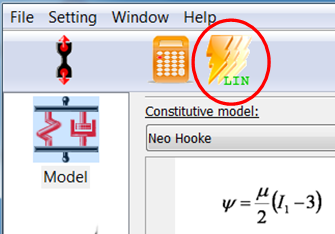
1/ Just only click on 'Fit parameters' button, that's all.
In fact, default material data (stress-strain curve of rubber), load protocol (uniaxial tension) and constitutive model (Neo-Hooke) have already been pre-selected automatically (if this is the first run of HYPERFIT).
 2/ Check the results -> parameters of the material model and its response in comparison with the used experimental data.
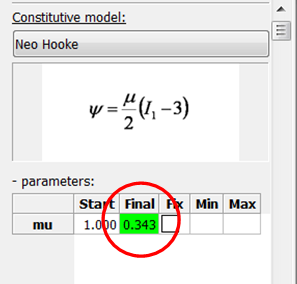
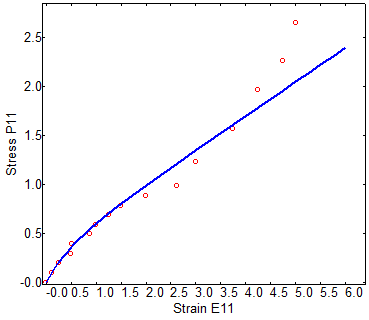
2/ Check the results -> parameters of the material model and its response in comparison with the used experimental data.
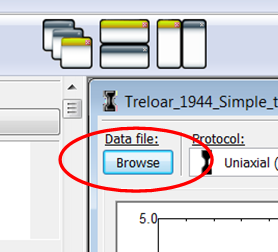
1/ Load your own material data (stress-strain curve):
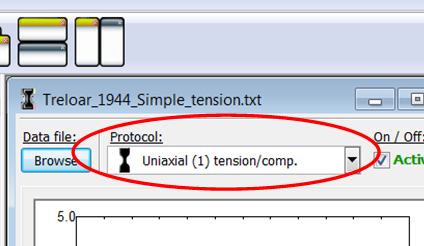
 2/ Select the proper load protocol associated with your material data:
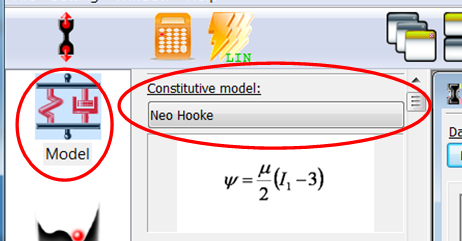
 3/ Select the material model you want to calibrate:
 4/ Start calibration process:
5/ Check the results -> parameters of the material model and its response in comparison with the used experimental data.
4/ Start calibration process:
5/ Check the results -> parameters of the material model and its response in comparison with the used experimental data.
2/ Select the proper load protocol associated with your material data:
3/ Select the material model you want to calibrate:
4/ Start calibration process:
5/ Check the results -> parameters of the material model and its response in comparison with the used experimental data.
1/ Load the first data-set (stress-strain curve) into the first (default) data-set window:
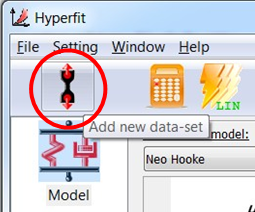
2/ Add new data-set window and load (from file) the second data set into this new window. Add as many data-sets as you want:
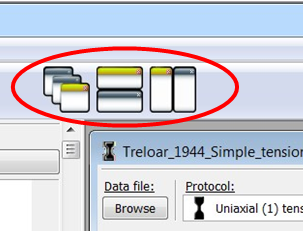
 3/ You can control and arrange all the data-set windows by 'Arrange' buttons or via menu/'Windows' (Alt-W):
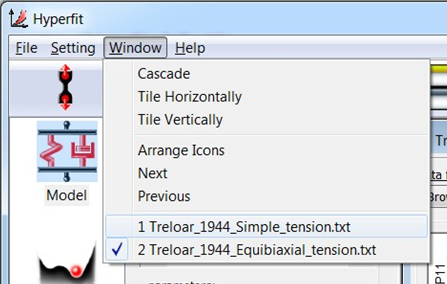 4/ Select the proper load protocols in all data-set windows:
5/ Choose the model and start calibration as usual:
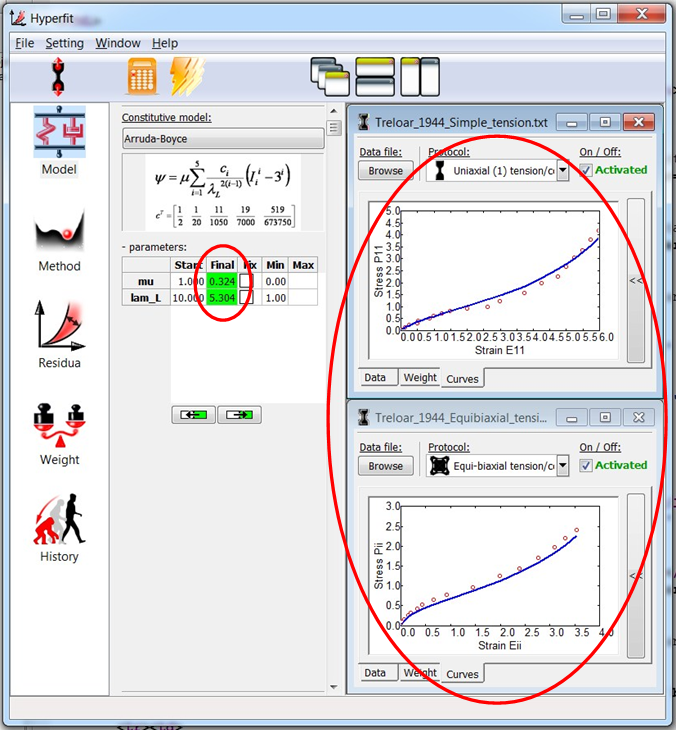
6/ Check the results -> one single set of material parameters and a number of model responses compared with experimental data in all the data-set windows.
4/ Select the proper load protocols in all data-set windows:
5/ Choose the model and start calibration as usual:
6/ Check the results -> one single set of material parameters and a number of model responses compared with experimental data in all the data-set windows.
2/ Add new data-set window and load (from file) the second data set into this new window. Add as many data-sets as you want:
3/ You can control and arrange all the data-set windows by 'Arrange' buttons or via menu/'Windows' (Alt-W):
4/ Select the proper load protocols in all data-set windows:
5/ Choose the model and start calibration as usual:
6/ Check the results -> one single set of material parameters and a number of model responses compared with experimental data in all the data-set windows.
1/ Choose the model and fill in its (known) parameter values into 'Final' column:
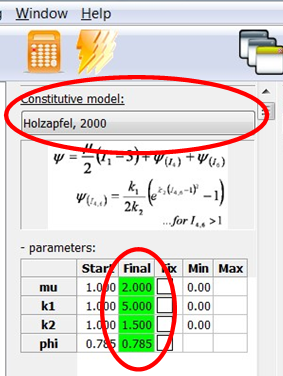 2/ Select the proper load protocol of the data-set(s):
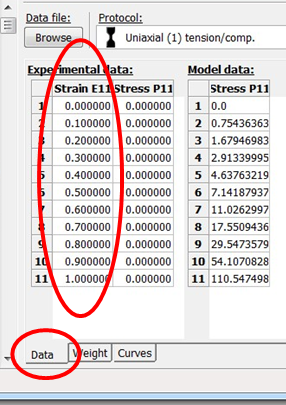
3/ Change the independent variable (strain) values of the data-set. You should add/delete/rewrite the data points to cover the required range of independent variable (strain). The final set of data-points represents the set of points where the model response (stress-strain curve) is calculated.
2/ Select the proper load protocol of the data-set(s):
3/ Change the independent variable (strain) values of the data-set. You should add/delete/rewrite the data points to cover the required range of independent variable (strain). The final set of data-points represents the set of points where the model response (stress-strain curve) is calculated.
 4/ Re-calculate the model response:
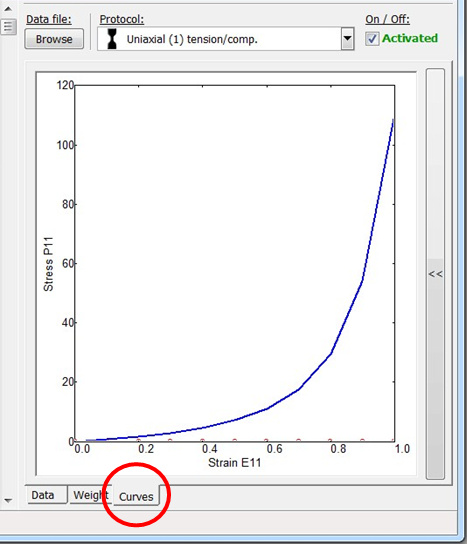
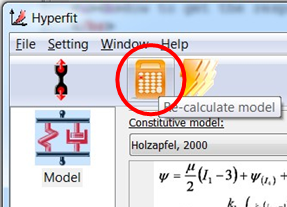 5/ Check the results -> model response:
- in graphics ('Curves' panel), you can save the model response into a bitmap-file
- in numbers ('Data' panel), you can save the model response into a text-file
2/ Select the proper load protocol of the data-set(s):
3/ Change the independent variable (strain) values of the data-set. You should add/delete/rewrite the data points to cover the required range of independent variable (strain). The final set of data-points represents the set of points where the model response (stress-strain curve) is calculated.
4/ Re-calculate the model response:
5/ Check the results -> model response: